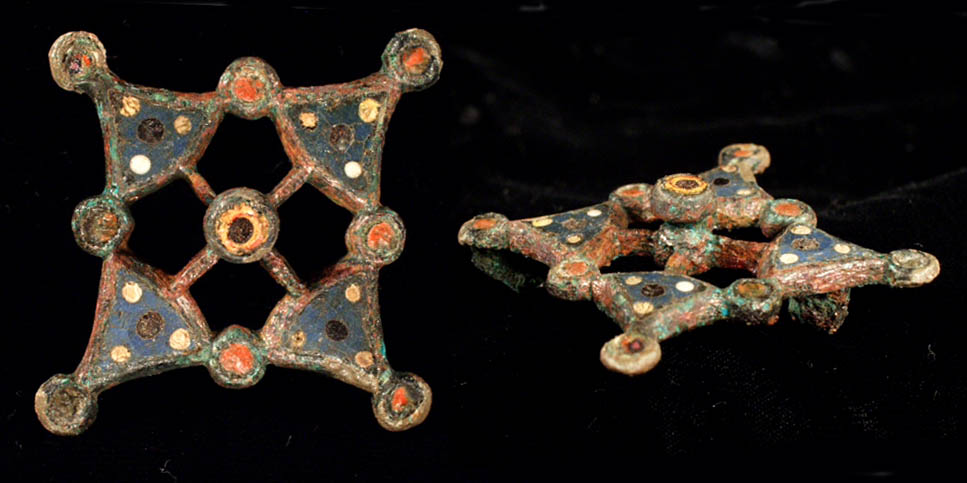
II-III c. A.D.
Rounded lobes at all corners of a square with concave sides, additional lobes in the middle of each side forming another open work square with concave sides and a riveted boss center filled with orange enamel. Each lobe is filled with red enamel. Each corner panel has a blue enamel background decorated with yellow, white and black enamel dots. Hinged pin has not survived.
1.9″x 1.9″(48 x 48 mm).
For the same type see: in British Museum: Johns C. The Jewellery of Roman Britain. Celtic and Classical Traditions. The University of Michigan Press, 1996, p.172, fig.7.14.